Ljuder Parish
The EmigrantsLjuder Parish is the Småland community the first group of emigrants leaves in 1850, a place where land, household, labor, and religious authority shape nearly every prospect in life. The novel presents it not merely as a point of origin but as a complete rural world: generations work the same soil, parish institutions regulate conduct, and departure makes familiar ground suddenly precious even as it becomes too narrow to sustain everyone.
Landscape and livelihood
Ljuder Parish lies in Konga County, roughly twelve miles long and three miles wide. Its black loam is mixed with sandy soil; two brooks and four lakes or tarns provide its limited open water. Pine forest, deciduous groves, and thickets once occupied much of the area later used as pasture. The setting is small in scale but not self-contained by accident: the parish’s inhabitants have long relied on the land and on the work their households can draw from it.
The novel describes its people as people of the soil, descended from generations who plowed and harrowed the ground they are about to leave. Sons take their fathers’ places in the fields; daughters follow their mothers at spinning wheel and loom. Rye supplies bread, cattle supply meat, and wool, flax, and animal skins become clothing and shoes through household work and itinerant trades. The farm is represented as a world of its own, exposed to the Lord’s weather but otherwise seemingly beholden to no power beyond its boundaries. In the low gray cottages, roofed with bark and sod, births, weddings, christenings, and wakes take place beneath the same rough-hewn pine beams. Between those events, the seasons mark the rhythm of life: green shoots in spring, yellow stubble in autumn.
Population and social pressure
That inherited order is under strain. On January 1, 1846, Ljuder had 1,925 inhabitants—998 males and 927 females. Over the century after 1750, its population had almost tripled, while the number of people outside the assessed landholding population—including old people, cottagers, squatters, servants, parish dependents, and those without permanent homes—had grown fivefold. These figures give demographic shape to the novel’s image of plots diminishing as children increase. The old rural economy remains the community’s foundation, but its capacity to provide for all its inhabitants is narrowing.
That pressure is not the only reason people leave, and the narrative distinguishes the familiar security of home from the uncertain prospect beyond it. News and rumors describe fertile land across the ocean, where newcomers might obtain soil to cultivate; pictures and hearsay are the first evidence of that country. The ocean is unknown and forbidding, while the home community is familiar. Thus migration begins as an uneven social movement: some hesitate, others dare, and a new restlessness reaches quiet hamlets through neighbors, parishes, and counties. The emigrants’ later suspicion that the crossing is much farther than they had been told makes the separation from home feel more final: their homeland becomes incalculably remote, while their destination remains remote too.
Authority and religious conflict
Ljuder’s social order is also defined by who governs it. In the 1840s, Dean Brusander represents spiritual authority, Sheriff Lönnegren represents the Crown and worldly rule, Lieutenant Paul Rudeborg holds local standing through noble birth and property, and Per Persson represents the parish on the county council. The account links these offices to the doctrine that authority comes from God, placing religious and secular power within a shared hierarchy.
That hierarchy is tested by the Åkian movement around Danjel Andreasson of Kärragärde. Brusander warns his congregation for three successive Sundays against private devotional meetings, reading an ordinance that threatens fines, imprisonment, or exile. He then excludes Danjel and his household from Communion and the church’s sacraments because Danjel persists in his Bible explanations. Kärragärde becomes a forbidden meeting place, and the dean’s effort to preserve religious order marks the parish as a community where faith is also subject to institutional permission.
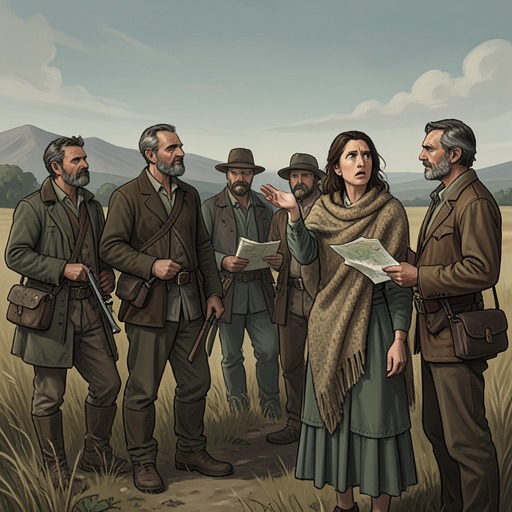
The conflict does not leave the parishioners with one settled judgment. Some want to drive Danjel and his followers out by force, but the dean insists that legal means must be used. Per Persson warns that Danjel’s generosity toward the poor and homeless is winning praise; if the parish divides into opposing parties, community peace may be threatened. The people gathered around Danjel include a former soldier, a poor and disabled woman, and Ulrika of Västergöhl, whom the dean regards with particular condemnation. The scene exposes a tension within the parish’s moral order: those whom respectable society marginalizes find welcome at Kärragärde, while their host’s religious dissent makes that welcome suspect to authority.
Departure and the changing meaning of home
The departure of the first emigrants turns the parish’s ordinary geography into a record of what is being relinquished. On the road toward America, Robert Nilsson jumps down at each gate to open it and counts five before Åkerby Junction. He counts even openings in pastures where the gates have been removed for winter, imagining that they would have been closed had the departure been delayed a month. His practical task as gate-boy becomes a way of measuring the road out of Ljuder: every opening registers movement away from the enclosed world of home.
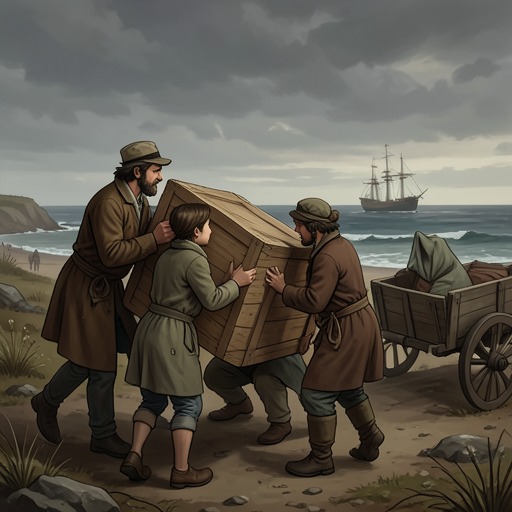
For Karl Oskar Nilsson and Kristina Johansdotter, the route passes familiar places they expect never to see again. Their children sleep in the wagon, while the parents silently attend to the brook where they once swam and the meadow where lilies of the valley bloom in spring. The memory-making is not abstract nostalgia; it is attached to specific landscapes that the travelers fear losing. At the coast, they encounter water without land on the other side for the first time in their lives. A cold wind greets them, and the people of the earth meet the sea before they have had time to behold it fully.
The passage does not make the sea a simple opposite of freedom. The emigrants find that the brig Charlotta is only forty paces long and eight wide, a confining space for nearly a hundred people. After a week at sea, Robert concludes that farm service on land, for all its harshness, offers more freedom than a sailor’s life bounded by the ship’s rail. The sea delays the emigrants with contrary winds, currents, and fog, making the homeland and the hoped-for new home seem equally distant. Ljuder therefore remains a measure of both constraint and belonging: the travelers have left its gates, but the journey first replaces the limits of land with the confinement and uncertainty of the ocean.
The parish left behind
The journey’s human cost gives the departure from Ljuder a sharp numerical form. Of the sixteen people who set out from the parish and gathered at Åkerby Junction in early April, fifteen reach the threshold of a new continent. Of the seventy-eight people who board at Karlshamn, seventy arrive; the Charlotta has given eight passengers to the ocean. The departure is collective, but survival is not guaranteed collectively.
Ljuder remains present in the emigrants’ identities even after it has become distant. The record of Inga-Lena Andersdotter’s death identifies her as the wife of Danjel Andreasson, from Kärragärde in Ljuder Parish, and preserves her birth and marriage details for the funeral. Such documentary particulars carry the home community into a burial at sea, where the customary ground of parish life is absent. In the novel’s structure, Ljuder is at once the material source of the migrants’ livelihood, the setting of their religious and social conflicts, and the remembered landscape against which the unfamiliar road, harbor, ship, and ocean acquire meaning.